“Missing and murdered indigenous women have disappeared not once, but three times,
in life, in the media and in the data.”
~ Missing and Murdered Native American Women Report,
Washington State Patrol, 2018
Missing and Murdered Indigenous women (MMIW) has been called an “epidemic” and a “crisis.” It’s a persistent iniquity perpetrated against Indigenous women and girls, not just through the violence itself, but in the failure of our institutions to track it and provide solutions of safety and accountability.
“Results show that more than four in five American Indian and Alaska Native women (84.3 percent) have experienced violence in their lifetime. This includes 56.1 percent who have experienced sexual violence, 55.5 percent who have experienced physical violence by an intimate partner, 48.8 percent who have experienced stalking, and 66.4 percent who have experienced psychological aggression by an intimate partner. Overall, more than 1.5 million American Indian and Alaska Native women have experienced violence in their lifetime.” ~ Violence Against American Indian and Alaska Native Women and Men,” National Institute of Justice, 2016
Washington State rated second-highest in the Nation for missing Indigenous women cases in urban centers and Seattle rated first among cities nation-wide in MMIWG cases with Tacoma rating 7th. ~ Urban Indian Health Institute, division of the Seattle Indian Health Board,
The State of Washington has enacted two pieces of legislation HB2951 in 2018 which increased services in reporting and investigating missing and murdered Native American women and HB1713 in 2019 which is to improve law enforcement response to missing and murdered Native American women. Oregon also passed MMIW legislation (BH 2625). While these pieces of legislation address some of the challenges of MMIW, there is a long way yet to go in identifying and addressing the causes and consequences of the violence against Indigenous women.
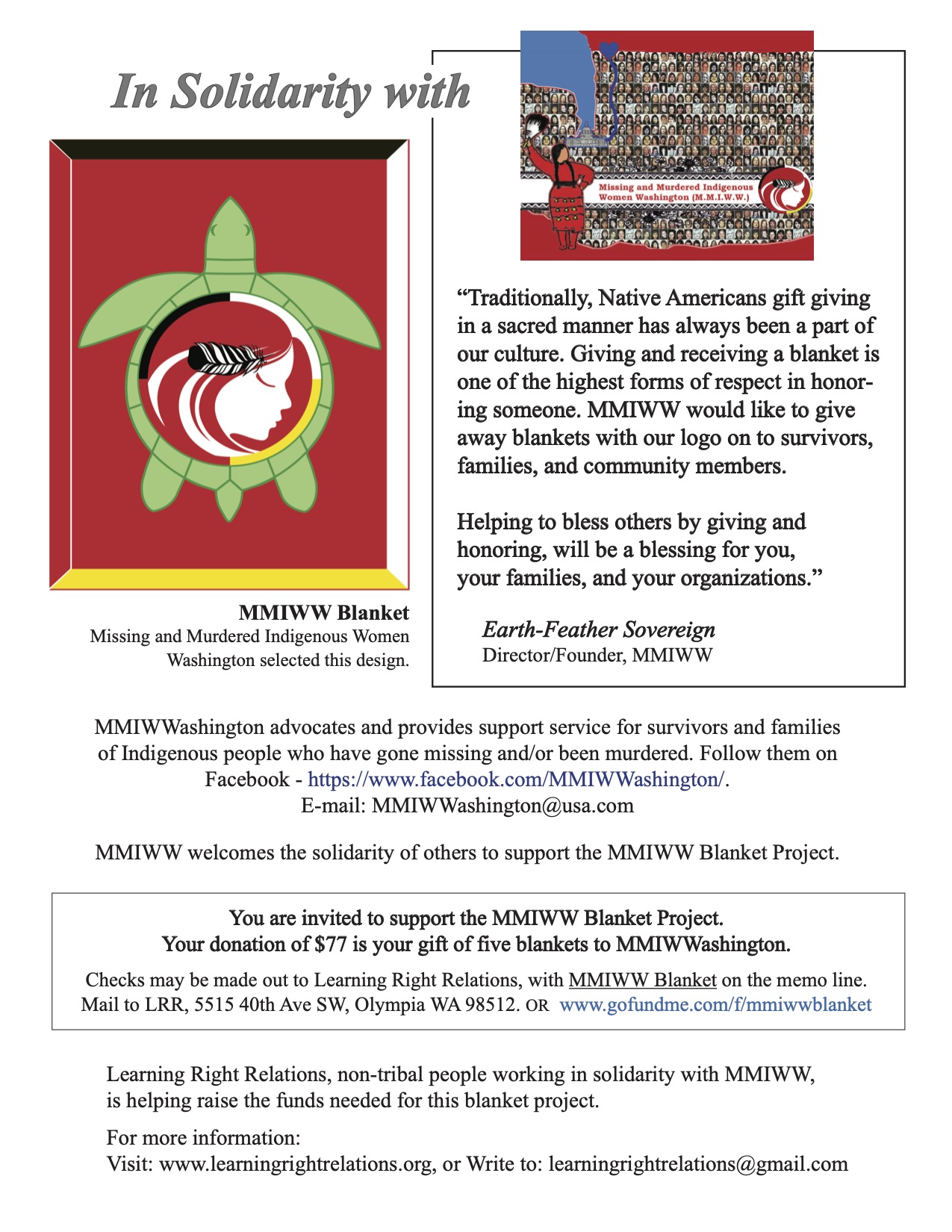
One response to the MMIW crisis and in support of Missing and Murdered Indigenous Washington (MMIWW), Learning Right Relations is currently sponsoring a MMIW Blanket Project.
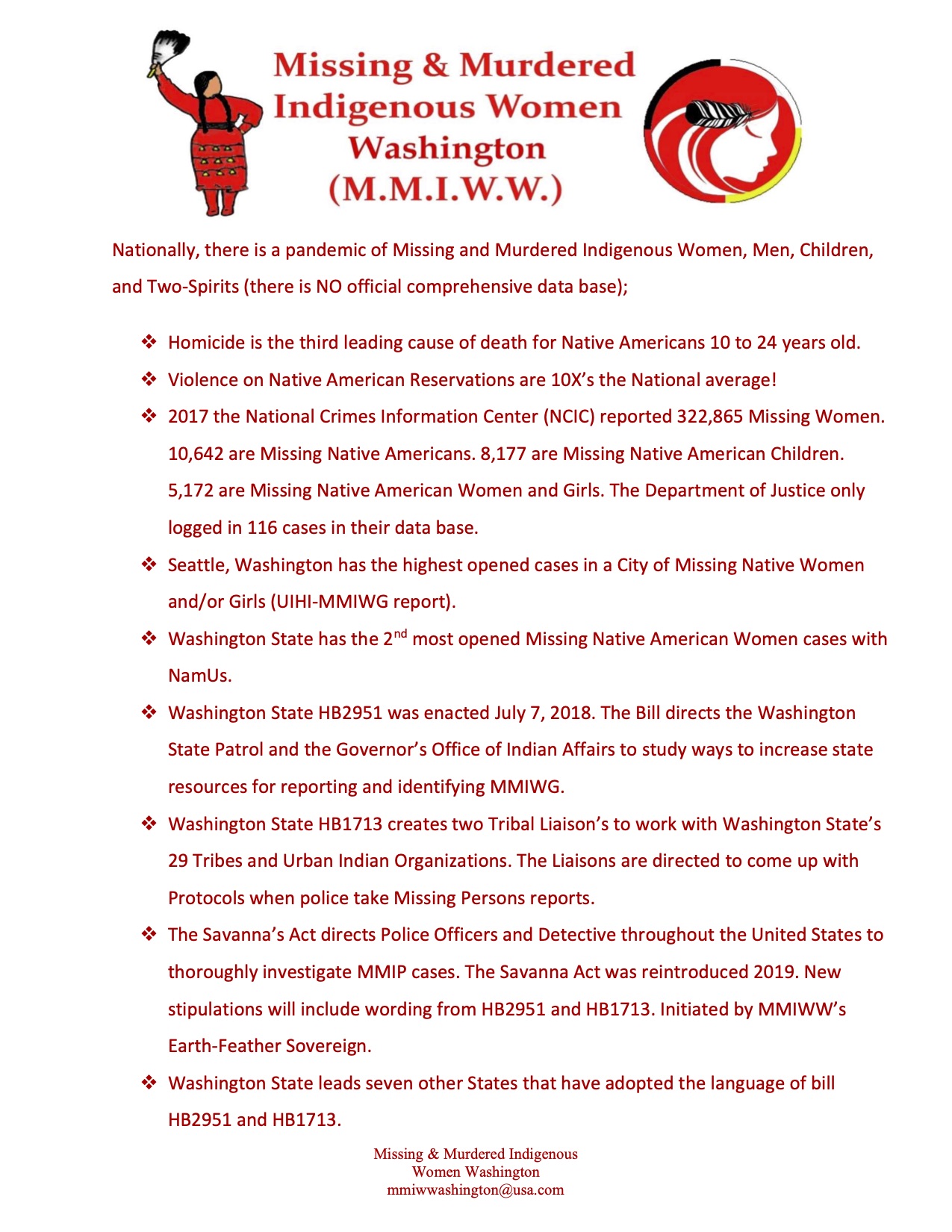
PDF files: MMIWW Blanket Handout and MMIWW Short Report.
Other resources and information are found below the blanket project information, so be sure to scroll all the way down. Please contact us with any additional information or resources so we can build up a more comprehensive MMIW resources list for the region.
Regional MMIW Organizations
Urban Indian Health Institute, a division of the Seattle Indian Health Board
Missing and Murdered Indigenous Women Washington
Missing and Murdered Indigenous Women USA
Alaska Native Women’s Resource Center
National Indigenous Women’s Resource Center (Alaska)
Idaho Council on Domestic Violence and Victims Assistance
Idaho Coalition Against Violence and Sexual Assault
MMIW Data Resources
Missing and Murdered Native American Women Report, Washington State Patrol, 2018
Violence Against American Indian and Alaska Native Women and Men, National Institute of Justice, 2016
“Missing and Murdered Women & Girls: A snapshot of data from 71 urban cities in the United States” Report, Urban Indian Health Institute, division of the Seattle Indian Health Board
Our Bodies, Our Stories, Urban Indian Health Institute
Idaho Summit on Missing & Murdered Indigenous People Report, December 2019
Films
Somebody’s Daughter (https://www.somebodysdaughter-mmiw.com)
Background Articles
Who are the missing Native women and how do we find them? Emily Washines, Crossut, August 15, 2019
Report: Seattle tops list of murdered and missing Indigenous women, Ashley Archibald, Real Change, June 12, 2019
Eastern Washington federal court will hire help for cases involving missing, murdered indigenous people, Samatha Wohlfeil, Inlander, December 5, 2019
Scope of Missing, Murdered Indigenous Women in Idaho Unknown, by Cyntha Sewell, Idaho Statesman
Why Are So Many Indigenous Women in Alaska Coming Up Missing and Murdered? by Jamie Bartosch, Arts & Entertainment, February 26, 2019
DISAPPEARING DAUGHTERS
The missing and murdered women of Juárez are more than statistics and data points. They are beloved daughters who have left behind an unimaginable and senseless void. They are the fuel of activism against impunity and injustice. They are the seeds of grief that blossom into art. And they are beautiful, fragile memories that must be preserved. Read more here and view the video. Very poignant.
MMIW: Petition for passing the Not Invisible Act.
Across the United States, over 5,700 indigenous women were reported missing in 2016 alone, with only 116 of those cases logged into the Department of Justice’s (DOJ) missing persons database. This statistic is the tip of the iceberg of the Missing & Murdered Indigenous Women (MMIW) crisis. But while seven states have taken steps to pass legislation to improve reporting mechanisms and data collection, and increase inter-agency collaboration, any such MMIW legislation has not passed on a federal level. Read more here and sign the petition, please.
Reclaiming Power and Place: National Inquiry into Missing and Murdered Indigenous Women
Executive Summary of the Final Report (Canada).
CUC Response to the Final Report of the National Inquiry into Missing and Murdered Indigenous Women and Girls (MMIWG)
The Missing and Murdered Indigenous Women Bill (WA-HB 1713 )
In the Washington State Legislature, HB 1713 on Missing and Murdered Indigenous Women has passed the House. Now onto the Senate . . . Read the bill history to date here and follow the bill's progress here.
House Committee on Public Safety Hearing on Improving law enforcement response to missing and murdered Native American women
The House Committee on Public Safety held a hearing on February 12, 2019, and the House passed on March 5, 2019, HB 1713, improving law enforcement response to missing and murdered Native American women. Staff reported that the State Patrol will conduct studies, working with tribes, and report on June 1, 2019 and propose legislation. Two liaison positions are established, one each for Western and Eastern Washington, and recruits must be involved in tribal communities. A task force is also established including tribal and law enforcement representatives. The task force would draft protocols and guidance on the issue of missing and murdered Native American women. The task force would report to governor by December 1, 2019.
You can take action on this bill by clicking on the link above, and click on “Comment on this Bill.” The comment link will take you to a page that requests your address and email information, a button where you can indicate support, oppose or neutral. You need to make a comment but it can be short – “please support the bill.”
Continue reading
Legislation Targets Missing And Murdered Indigenous Women Epidemic
Savanna’s Act co-sponsored by U.S. Sen. Maria Cantwell (D-WA); Seattle and Washington rank among highest in nation
This congressional session, U.S. Senators are stepping up efforts to address the epidemic of missing and murdered indigenous women through the introduction of legislation designed to enhance record keeping, create law enforcement protocols, and provide crime victim services to native communities. One such measure includes Savanna’s Act, which was introduced by U.S. Sens. Maria Cantwell (D-WA), Catherine Cortez Masto (D-NV), and Lisa Murkowski (R-AK) on Jan. 28. It is designed to address the scant recording of missing and murdered indigenous women and girls. Named after Savanna LaFontaine-Greywind, a member of the Spirit Lake Tribe who went missing during her pregnancy in 2017 and was later found dead in a river, the act seeks to improve tribal access to federal crime databases. It ultimately failed in the House of Representatives. The re-introduction of the legislation followed the Washington state Senate House Bill 2951, which became law last June and is also designed to bolster data collection of missing and murdered indigenous women. Read more here.Continue reading
Why Are So Many Native American Women Abused, Missing and Murdered?
Take action! Go to the website below read the bill and comment on this legislation. "At the state level, Republican Rep. Gina McCabe introduced a House bill in Washington State that would bring the federal, state, and federally recognized sovereign tribal governments together to ensure that everyone in the state who goes missing is reported and listed in a central location. The bill, now making its way through the legislative process, mandates that the State Patrol creates a list of missing Native American women in Washington by June this year, working together with tribal and non-tribal police agencies."
Continue reading
We are the change - A March for Women 3.0
Sunday, January 20, 2019 at 10 AM – 2 PM
Occidental Square, 117 S Washington St, Seattle, Washington 98104
Heading into our 3rd year of the Women's March, We hear you! We hear our local communities and we believe that no one stands alone. It will take all of us to create real change.
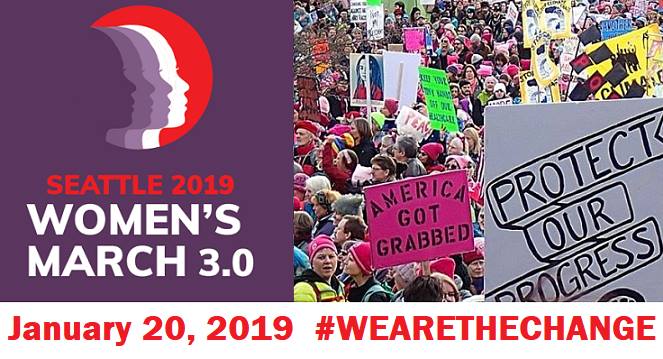 We ask you to participate on Sunday and continue taking part in your communities all year around. Human trafficking happens in your own backyard, Missing and Murdered Indigenous Women of Washington should not happen, Rape kits sitting on shelf for years should not be acceptable. Children sleeping outside as they are without a home should not be the norm, Environmental Justice isn't just two words. We are highlighting what we CAN change not just yell and get our frustrations out for a day.
Read here for more info.
We ask you to participate on Sunday and continue taking part in your communities all year around. Human trafficking happens in your own backyard, Missing and Murdered Indigenous Women of Washington should not happen, Rape kits sitting on shelf for years should not be acceptable. Children sleeping outside as they are without a home should not be the norm, Environmental Justice isn't just two words. We are highlighting what we CAN change not just yell and get our frustrations out for a day.
Read here for more info.
Continue reading
‘Justice for Jackie’ gets police use of deadly force bill onto Washington ballot
Continue reading
Tribal leaders pitch Congress on farm bill, Violence Against Women Act
Tribal leaders pitch Congress on farm bill, Violence Against Women Act
by
Continue reading
