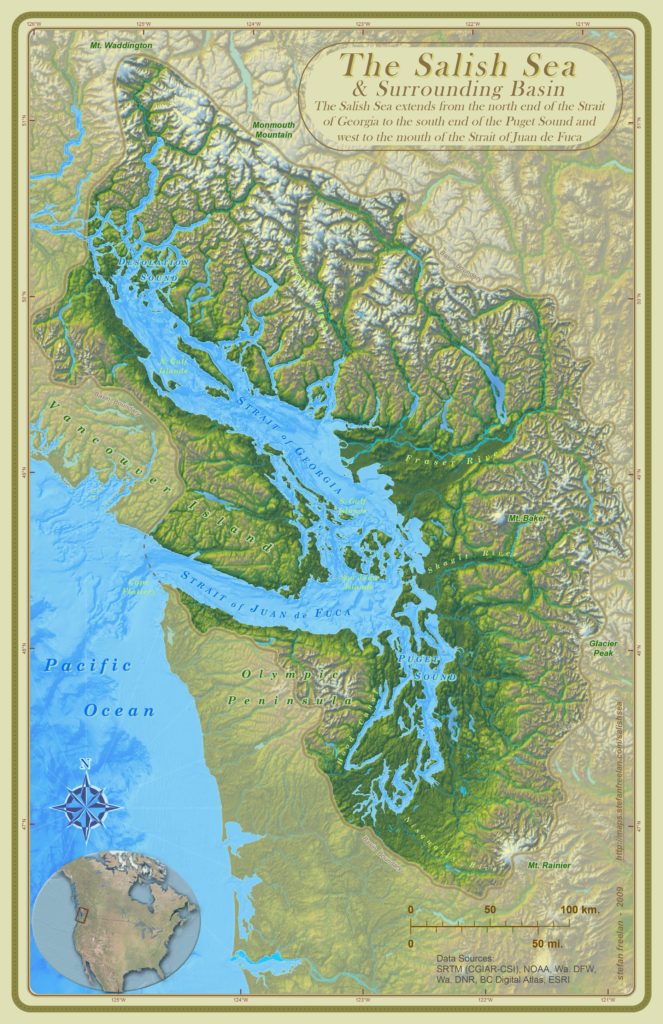
In this space we will be building the story of the Salish Sea, sharing the indigenous perspective and interpretation of the gifts and wonders of this sacred space. We have very challenging issues here with the fossil fuel and other industries, pollutants and toxins on land and in the water, congestive vessel traffic and shipping noise, severe adverse impacts on wild/marine life to the point of several Endangered Species Act listing, disputes with Treaty Rights, and more.
It’s a space with a place in time immemorial, with a sacred name. It deserves our respect and our due diligence.
Here are some resolutions passed by the Affiliated Tribes of Northwest Indians:
ATNI Resolution-18-32: 2018 Mid-Year Convention – “TOKITAE, THE SOUTHERN RESIDENT KILLER WHALE POPULATION, AND THESALISH SEA: OUR SACRED OBLIGATION”
ATNI Resolution 19-29: 2019 Mid-Year Convention – “THE SALISH SEA AND OUR SACRED OBLIGATION”
JUUstWA Signs onto NGO ltr on the Columbia River Treaty
Association of Northwest Steelheaders ● Boulder-White Clouds Council ● Center for Environmental Law and Policy ● Columbia Riverkeeper ● Deschutes River Alliance ● Earth Ministry/Washington Interfaith Power & Light ● Federation of Western Outdoor Clubs ● Faith Action Network ● Great Old Broads for Wilderness ● Greater Hells Canyon Council ● Idaho Conservation League ● Idaho Rivers United ● Idaho Wildlife Federation ● JUUstice Washington ● League of Women Voters of Washington ● Native Fish Society ● Nimiipuu Protecting the Environment ● Northwest Guides and Anglers Association ● Oregon Coast Alliance ● Oregon Wild ● Portland Audubon ● Save our Wild Salmon Coalition ● The Lands Council ● WaterWatch of Oregon ● Washington Wildlife Federation ● Washington Wild ● Wild Orca ● Wild Steelhead Coalition ● Snake River Waterkeeper ● Sierra Club
Why Remove The 4 Lower Snake River Dams?
 The Northwest would not be what it is today without hydroelectricity from the region’s dams. Yet one simple fact remains: not all dams are created equal. Below is a list of commonly asked questions about Columbia and Snake River salmon and the four lower Snake River dams with answers from regional stakeholders.
Also check out the Myths & Facts page.
1. Why do scientists support partial removal of the 4 lower Snake River dams?
The Northwest would not be what it is today without hydroelectricity from the region’s dams. Yet one simple fact remains: not all dams are created equal. Below is a list of commonly asked questions about Columbia and Snake River salmon and the four lower Snake River dams with answers from regional stakeholders.
Also check out the Myths & Facts page.
1. Why do scientists support partial removal of the 4 lower Snake River dams?
Sound the Alarm!
Watch this video of a recent massive mobilization call to alert allies and friends from coast to coast that Wet’suwet’en people need their help to Stop The Drilling under their sacred headwaters, Wedzin Kwa. Attendees will hear from Sleydo’, Chief Na’Moks, and Chief Woos about what’s happening right now on the Yintah. You’ll hear about the violence, surveillance and intimidation that is escalating on Wet’suwet’en territory, and what they can do to help stop the drilling and call off the RCMP. https://youtu.be/XBMji4358vI
The Upper Skagit Indian Tribe calls on Seattle to remove the Gorge Dam
This article is one of a pair of stories about the Skagit River and the federal process to relicense three major hydroelectric dams along its length. Read the companion story here. As he explored his ancestral homeland, Schuyler visited the upper Skagit River Valley, where he encountered the Gorge Dam. When the city of Seattle decided to dam the Skagit River in the early 1900s, it chose a sacred area known as “The Valley of the Spirits,” without consulting the Upper Skagit, who at the time were fighting for their survival. “You look throughout the world’s cultures,” Schuyler said, “when they have their individual stories in their culture of how life began, this is it for us. I can’t explain the emotions of seeing this historic wrong, and the hurt.” Read more here.
2nd Call for Support: Bring Sk'aliCh'elh-tenaut Home!
Netse Mot: Support Lummi Nation and Xw’ullemy (the Salish Sea)
2nd Call for Support: Bring Sk'aliCh'elh-tenaut Home!

Have you?
Red Road to DC Totem Pole Journey
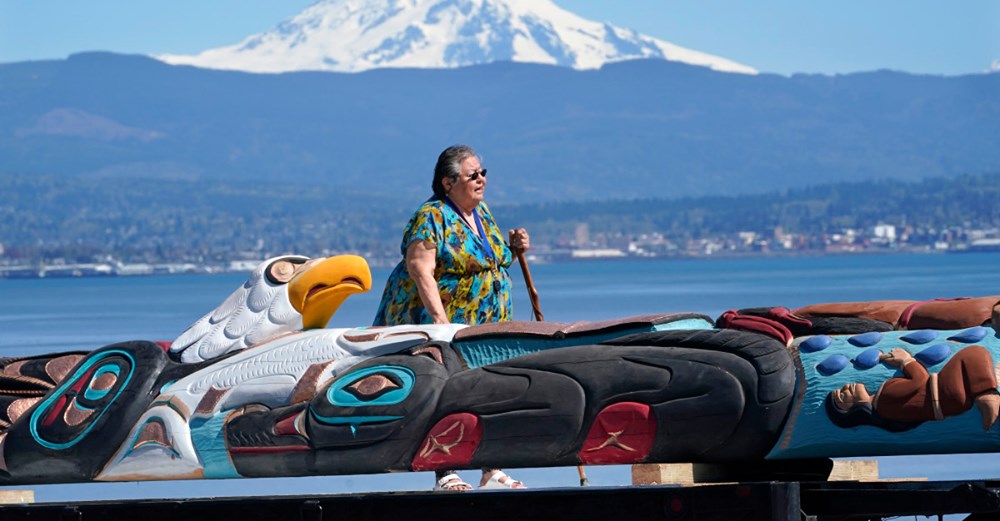
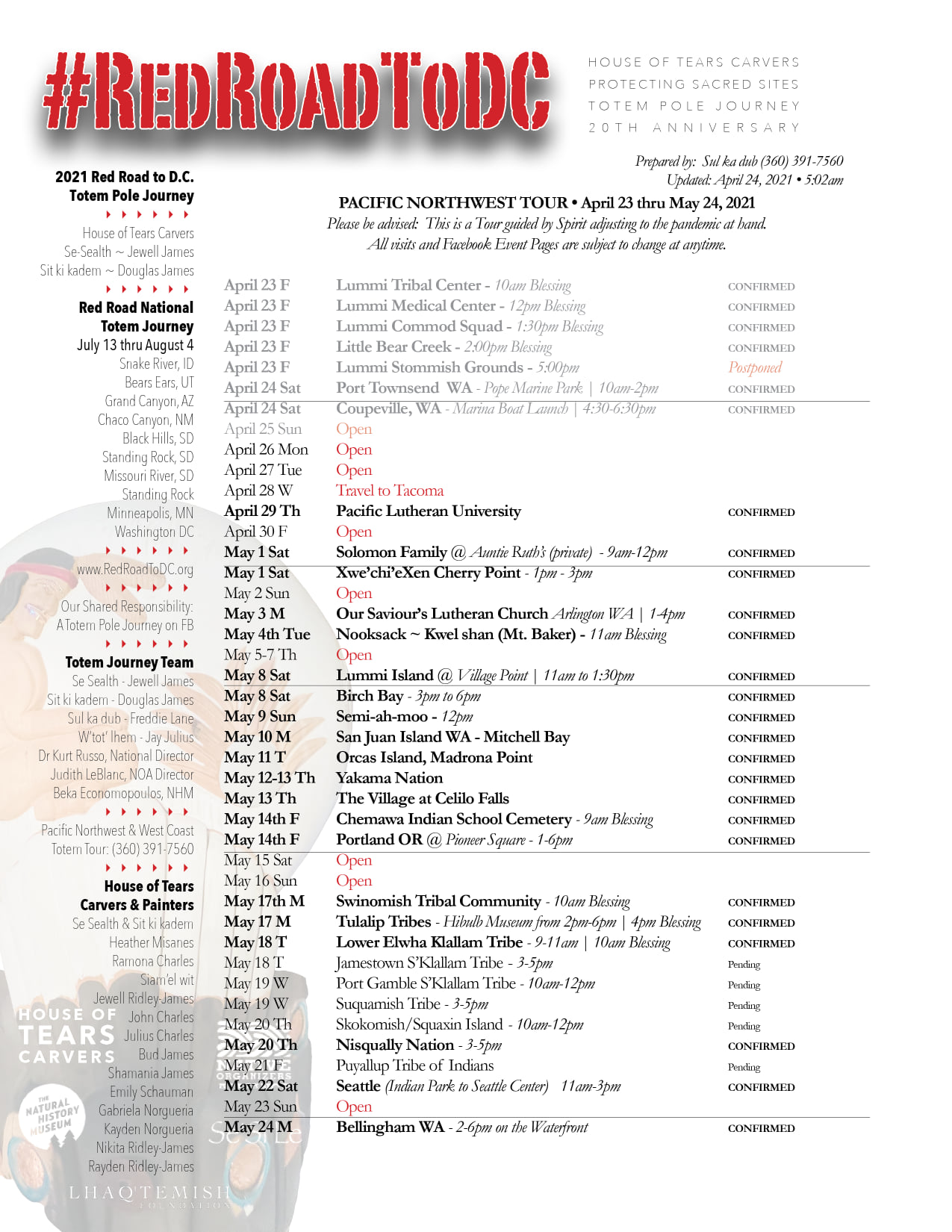
Netse Mot: Bringing Sk'aliCh'elh-tenaut Home!
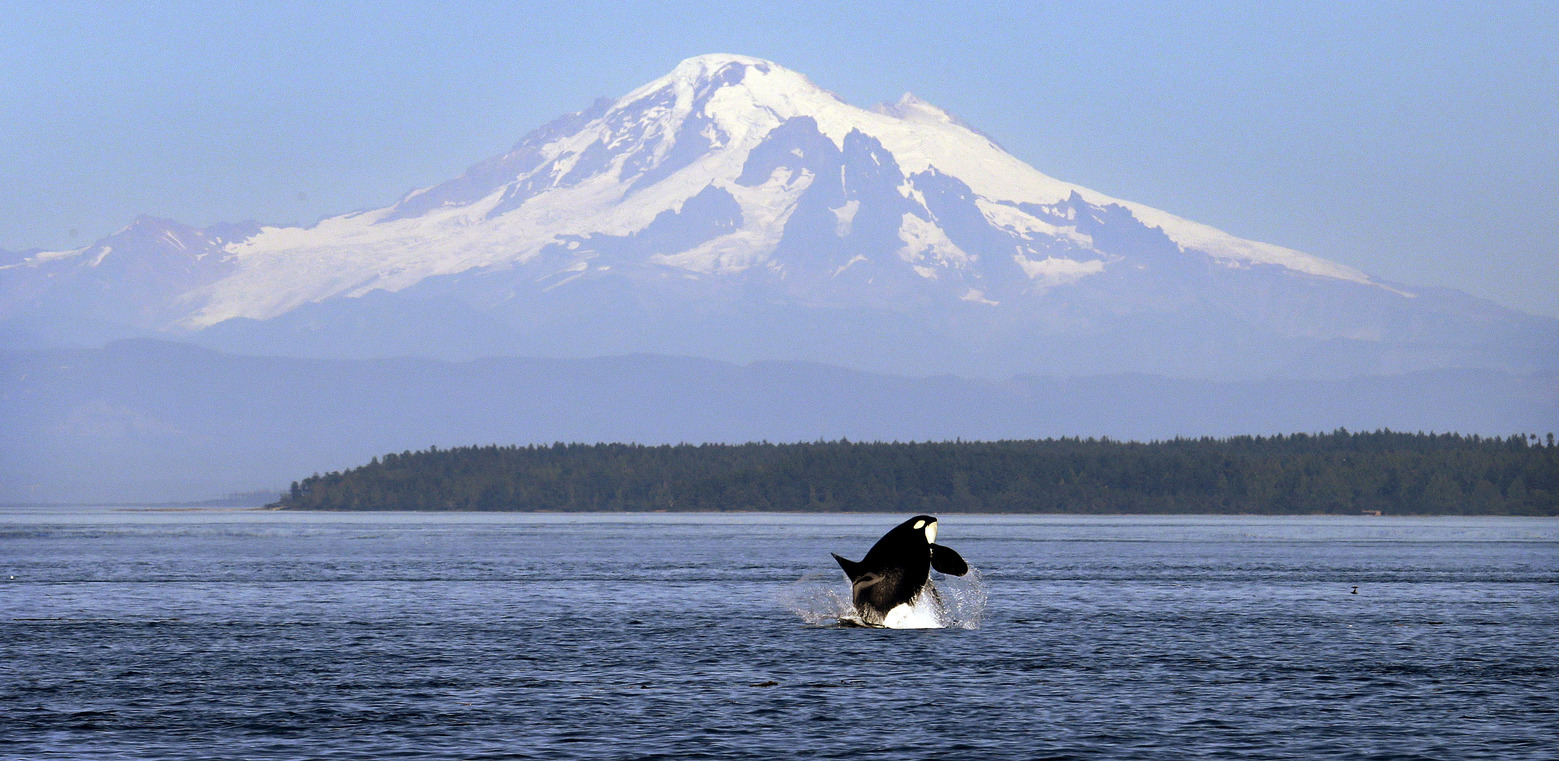
Netse Mot 2021-Call to bring Sk'aliCh'elh-tenaut Home
2021 will focus on the return of Sk'aliCh'elh-tenaut (Tokitae/Lolita) to the Pacific Northwest from Miami Seaquarim in Florida. In the 1970s Southern Resident Orca youth were forcibly and violently taken from their pods and shipped out to aquariums and parks all over the world. Sk'aliCh'elh-tenaut (Tokitae/Lolita) was taken to Miami Seaquarium where she is the last surviving Orca youth taken. Lummi Nation has been trying for decades now to have her returned but Miami Seaquarim is refusing to release her. In 2019, two Lummi women, Squil-le-he-le and Mah Tahs working with Earth Law Center, invoked the Native American Graves Protection and Repatriation Act (NAGPRA) and announced their intent to sue Miami Seaquarium if the Seaquarium. To date (April 2021), Miami Seaquarim is still refusing to release Sk'aliCh'elh-tenaut. Squil-le-he-le and Mah Tahs are calling upon us to respond as well.- For individuals, they are asking that we sign the petition established by Earth Law Center that is collecting signatures to go to Miami Seaquarim and its parent and affiliates—Palace Entertainment and Parques Reunidos Servicios Centrales SA.
- For groups and organizations, they are asking that we sign a request to Governor's Inslee (WA) and Brown (OR) and BC Premier John Horgan to sign a proclamation to support the efforts to bring her home. Please sign by 24 May 2021. We'd like to present it to the Governors in June during Orca Action Month.
- We are also being asked to reach out to other Indigenous connections we may have and invite them to sign the Indigenous Statement of Solidarity. The request also includes a video of ceremonies in solidarity. If you have connections with an Indigenous group, please ask them to contact Julie at info@sacredsea.org.
Planned Roberts Bank Terminal Threatens Orcas
Washington state has made significant commitments to and investments in the protection and recovery of these killer whales, their critical Salish Sea habitat, and their food web, which hinges on the availability of Chinook salmon. The terminal will threaten the progress made to date on recommendations of the Governor’s Orca Task Force and on state legislation that has ensued from its deliberations. Even ignoring the added risks of oil spills and ship strikes, there would still be a major increase in underwater noise levels from these massive container ships that will further limit the orcas’ ability to echolocate, communicate and hunt. Over 40 organizations and nearly 100,000* individuals have asked Governor Inslee to oppose the Roberts Bank terminal project, signing a petition addressed to him. And they have asked that if the project is approved in spite of their strong objections, he should insist that robust risk-mitigation measures — such as an emergency tug strategically located along the vessels’ path — be required to protect the orcas, salmon and Washington state environment. Read more here.
Roberts Bank Container Terminal Threatens Orcas
As currently planned, Roberts Bank Terminal 2 (RBT2) would be built in the sub-tidal waters of the Fraser River delta adjacent to the Westshore coal terminal, on 437 acres of critical habitat for salmon and migratory birds. Once in existence, it would significantly increase the Port’s capacity for larger container ships and also induce more container-ship traffic through the trans-boundary waters of the Salish Sea — by up to 520 transits per year. The massive “Mega-Max” container ships that could call on this terminal typically carry 18 to 24 thousand containers. They can also carry much larger amounts of propulsion fuels, in some cases over 4 million gallons worth, which could dramatically increase the extent of an oil spill from a container-ship collision or grounding. Read more here.
Report: Salmon in WA are ‘teetering on the brink of extinction’
Washington’s salmon are “teetering on the brink of extinction,” according to a new report. It says the state must change how it’s responding to climate change and the growing number of people in Washington. Washington’s State of Salmon in Watersheds report says time is running out for the Northwest’s iconic fish. The report shows a trend of warming waters and habitat degradation is causing trouble for its salmon runs. Ten of the 14 threatened or endangered salmon and steelhead runs in the state are not getting any better. Of those, five are “in crisis.” Read more here.
Bring Sk’aliCh’elh-tenaut Home!
Special Alert!
 Bring Sk’aliCh’elh-tenaut Home!
A sacred request from
Squil-le-he-le (Raynell Morris) and
Tah-Mahs (Ellie Kinley)
"Our Lhaq'temish [Lummi] people have had a special relationship with our killer whales since time immemorial. We know them as qwe’lhol’mechen, which means “people under the water.” Our stories tell of intermarriage and kinship between our Lhaq'temish people and a local qwe’lhol’mechen clan we know as Sk’aliCh’elh.
Fifty years ago, as our own children were being stolen and sent to boarding schools, one of the Sk’aliCh’elh children was stolen and sold to the Miami Seaquarium. We call this orca whale “Sk’aliCh’elh-tenaut,” which means daughter of Sk’aliCh’elh. She is our Lhaq'temish daughter, too. She has been held in a small concrete tank and forced to perform for her food since 1970.
The United Nations Declaration on the Rights of Indigenous People recognizes and uphold our rights to our culture, our spirituality, our families. In order for our Lhaq'temish culture, spirituality, and family to be whole, we must bring Sk’aliCh’elh-tenaut home. We are working with the world’s top scientists and experts on how to do this responsibly. We have a plan, but we do not yet have Miami Seaquarium’s agreement to release her into our care.
We are asking all individuals to sign our Petition, as put forth by our partners at the Earth Law Center."
Hy’shqe,
Squil-le-he-le (Raynell Morris)
Tah-Mahs (Ellie Kinley)
Enrolled members of Lummi Nation
Please pass this onto family, friends, allies and partners. Ask them to sign the petition. It is believed that an overwhelming show of support, Miami Seaquarium’s parent companies might do the right thing and allow the Lhaq'temish people to bring their relation home to the Salish Sea, where they and her orca family await her.
For more information, check the links below:
Links:
- Ceremonies for Ska’liCh’elh-tenaut Facebook page: https://www.facebook.com/Ceremonies-for-Skalichelh-tenaut-111624844000057
- SacredSea.org Sk’aliCh’elh-tenaut page: https://sacredsea.org/skalichelhtenaut/
- Petition link: https://www.change.org/p/miami-seaquarium-free-endangered-orca-held-captive-at-miami-seaquarium-for-50-years
- SacredSea YouTube channel: https://www.youtube.com/channel/UC0qWShmGWtn3HPU-cpWj81Q
Seaquarim's Shame: Episode 2 - Talequah
A mother orca grieves the death of her only minutes old baby in the Salish Sea in the summer of 2018. The world media becomes fixated. 4 years later she has a new baby boy, Phoenix. A landlocked girl from Ohio won’t let her dreams of the sea go unrealized. Be there as has her first encounter with an orca. Today she is an accomplished marine naturalist & creator & hosts one of the best podcasts on the Southern Residents: Breaching Extinction. A Vietnam war veteran discovers Indian Country, finding where things feel right, after years on a motorcycle discovering America. Meet an ally of The Lummi First nation who’s been witness & supporter in their fight to save the Qw'e lh'ol me chen.
Listen here.
Seaquarim's Shame: Episode 1 - Tokitae
Something is wrong at Miami Seaquarium.. They have been keeping an orca who doesn’t belong to them for over 50 years. A produce salesman turned vegan activist fights for over a decade on the street corner in front of Miami Seaquarium, turning away thousands of cars. A new legal fight launches in 2020 headed by The Lummi Nation of the Pacific North West. Still: 19,785 days later Lolita the whale remains alone in the smallest tank in the world. Episode 1: Tokitae
Listen here.
Podcast | Past the dams, tribes help the Columbia River roll on
Few rivers define a region like the Columbia, where tribal scientists are making headway in bringing back its most important species: salmon.
Billy Frank Jr. could replace Washington’s statue of Marcus Whitman
As lawsuits mount, government looks into removing Electron Dam
Just last week, the Puyallup Tribe announced it was suing the owner of the dam, Electron Hydro, LLC, over a long list of environmental hazards and permit violations — including a fish kill that caused the death of thousands of fish and the pollution of the river with un-permitted artificial turf, both of which occurred during construction last summer. That’s in addition to a lawsuit from the Department of Justice over the Clean Water Act. That lawsuit is specifically in response to the artificial turf incident, in which hundreds of cubic yards of turf that dam owner Electron Hydro had placed in the river disintegrated into crumb rubber and flowed downstream to the Puget Sound. Read more here.
For tribes, climate change fight is about saving culture
The Tulalips are expanding efforts to protect land and water that are integral to their identity.
When Terry Williams grew interested in climate change in the 1970s, he found information about human-caused global warming to be conflicting and confusing. “It didn’t make sense until the early ’80s, when we saw a difference in the timing of the floods,” the Tulalip Tribes elder recalled. Later studies bore out what was happening in the tribes’ traditional lands. “The glaciers were melting two to three months early. We got floods in November and December instead of March and April. Rainfall had increased 6%.” The 5,000 enrolled Tulalip citizens are primarily from the Snohomish, Snoqualmie and Skykomish tribes. In three river systems with the same names, ever-bigger and earlier floods wash away salmon eggs or bury them in river sediment. Higher water temperatures may kill fish that do manage to hatch. They never make it to Puget Sound. If salmon can’t survive, what will happen to a Native culture based on a plentiful supply? Read more here.
Salmon spawn in the upper Columbia after an 80-year hiatus
Bringing salmon back to the Upper Columbia has been a goal since the habitat was blocked by the Chief Joseph and Grand Coulee dams more than eight decades ago. Tribal members held the Ceremony of Tears 80 years ago when the final run of salmon returned. “Our ancestors carried a prayer that our salmon would one day return to the Upper Columbia. With all the prayers that were made historically and today, combined with all the efforts of our fisheries staff, our leaders and many others who are joined in this effort, we can bring our fish home,” Colville Business Council chairman Rodney Cawston said in a statement. In a 2019 ceremony, Colville members released 30 salmon above Chief Joseph Dam and, a few days later, above Grand Coulee. It was the first time salmon had returned to their traditional waters. Read more here.
US Army Corps of Engineers rejects Pebble Mine permit application, likely killing project
On Wednesday, 25 November, the U.S. Army Corps of Engineers denied the permit application for the proposed Pebble Mine, an open-pit copper, gold, and molybdenum extraction project proposed for the headwaters of Bristol Bay, Alaska – North America's most prolific salmon habitat. The Corps “determined that the applicant’s plan for the discharge of fill material does not comply with Clean Water Act guidelines and concluded that the proposed project is contrary to the public interest,” Col. Damon Delarosa, commander of the Corps in Alaska, said a prepared statement, according to Alaska Public.