For environmental justice actions and events in the Unitarian Universalist Network, please sign up and log in at createclimatejustice.net/
July 2024 |
||||||
|---|---|---|---|---|---|---|
| Mon | Tue | Wed | Thu | Fri | Sat | Sun |
|
1
|
2
|
3
|
4
|
5
|
6
|
7
|
|
8
|
9
|
10
|
11
|
12
|
13
|
14
|
|
15
|
16
|
17
|
18
|
19
|
20
|
21
|
|
22
|
23
|
24
|
25
|
26
|
27
|
28
|
|
29
|
30
|
31
|
||||
Letter Writing to NoDAPL Political Prisoners, April 6, 2021, 4pm, Online
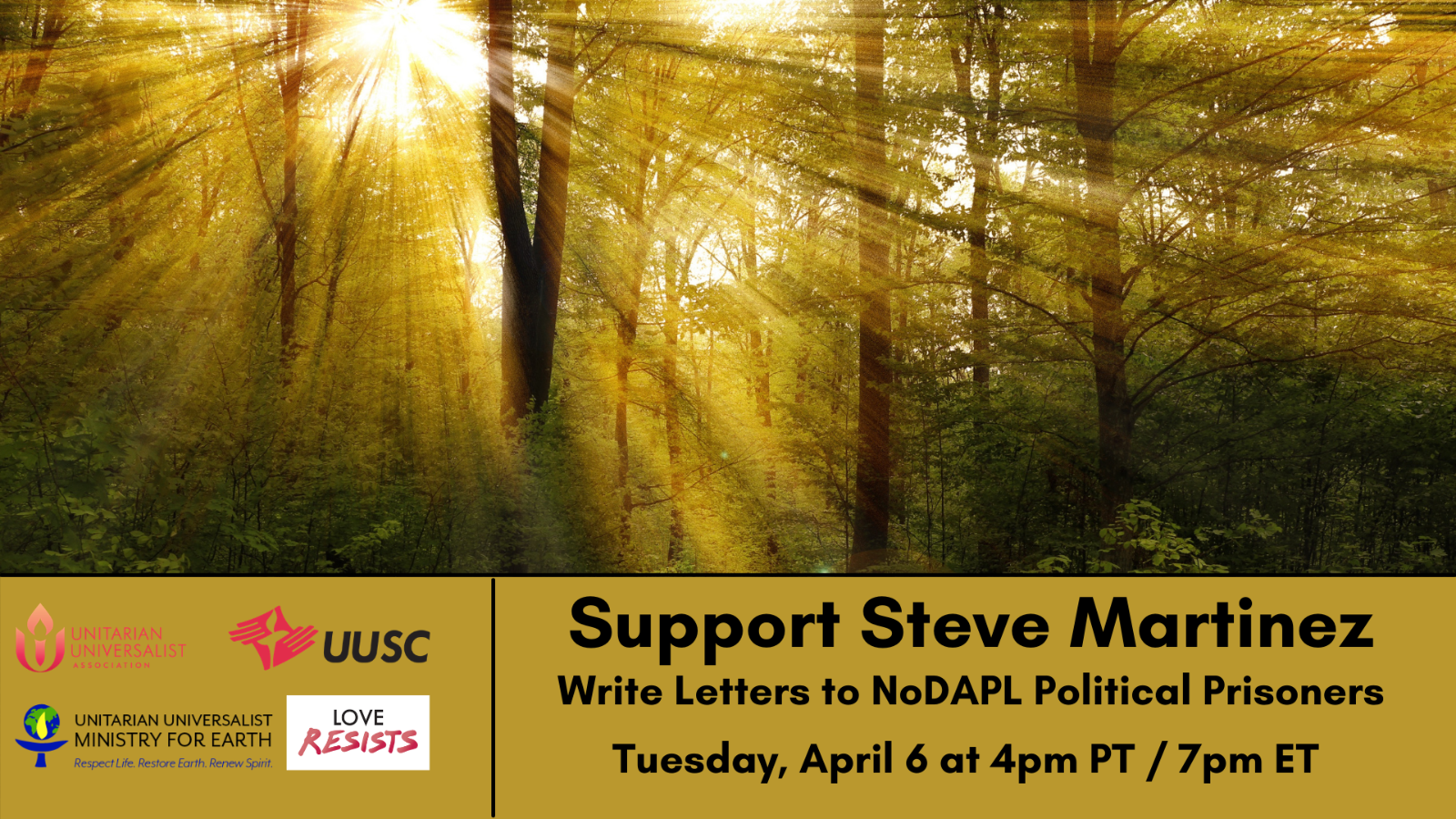 Join the Unitarian Universalist Association, UU Ministry For Earth, UU Service Committee and Love Resists for a letter writing campaign to show solidarity with Steve Martinez, a NoDAPL political prisoner who has been recently incarcerated after refusing to face a grand jury for a second time. Steve, an Indigenous water protector, was first subpoenaed to a federal grand jury in 2017 for his participation in the NoDAPL resistance movement and refused to comply then as now. This recent targeting came as a disconcerting surprise to many who have been supporting water protector political prisoners for the past four years. On the call, hear from Water Protectors and UU organizers about Steve’s current legal situation, and write your own letter to Steve and other NoDAPL political prisoners.
Register here
Another way to support is to DONATE to Steve Martinez’s GoFundMe.
Join the Unitarian Universalist Association, UU Ministry For Earth, UU Service Committee and Love Resists for a letter writing campaign to show solidarity with Steve Martinez, a NoDAPL political prisoner who has been recently incarcerated after refusing to face a grand jury for a second time. Steve, an Indigenous water protector, was first subpoenaed to a federal grand jury in 2017 for his participation in the NoDAPL resistance movement and refused to comply then as now. This recent targeting came as a disconcerting surprise to many who have been supporting water protector political prisoners for the past four years. On the call, hear from Water Protectors and UU organizers about Steve’s current legal situation, and write your own letter to Steve and other NoDAPL political prisoners.
Register here
Another way to support is to DONATE to Steve Martinez’s GoFundMe.
Electric Vehicles: the Impacts and Realities, with Landscape Architect Robert Colón, March 25, 5 pm, online.
Electric Vehicles are touted as a key component to solving our climate crisis. Many consumers are jumping on the EV bandwagon, and companies like Amazon are building a fleet to ship goods by electric truck. Likewise, national environmental organizations are pushing EVs as key to lowering GHG emissions and transitioning to a green economy.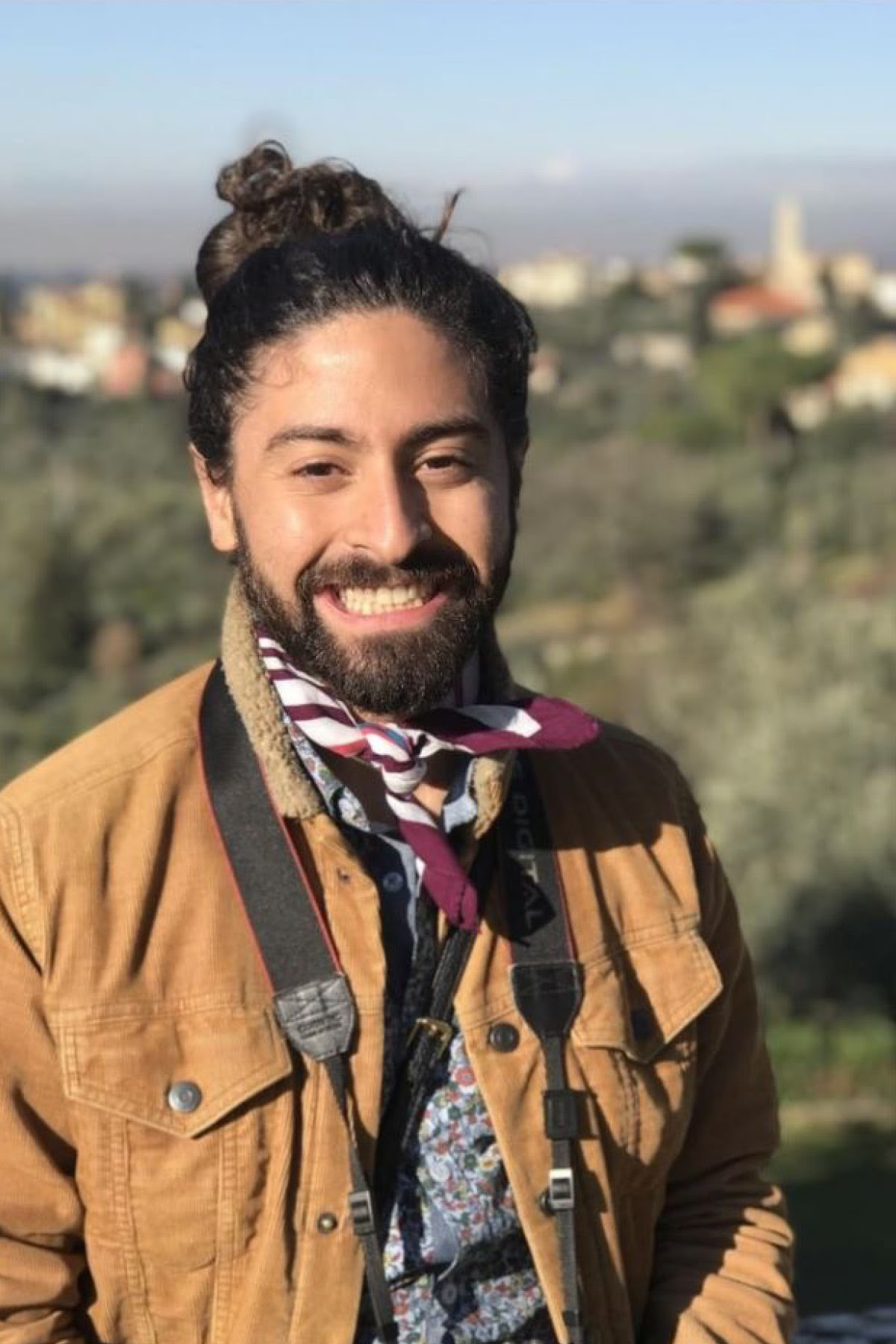 But are EVs a real climate solution? They can be, but ONLY if they coincide with mode shift from roads to rail, mass transit and passenger rail development, redesign of communities, battery recycling technology, and mitigation of lithium mining impacts.
Anything short of these co-occurring developments is contrary to the Green New Deal vision.
We need to ask:
But are EVs a real climate solution? They can be, but ONLY if they coincide with mode shift from roads to rail, mass transit and passenger rail development, redesign of communities, battery recycling technology, and mitigation of lithium mining impacts.
Anything short of these co-occurring developments is contrary to the Green New Deal vision.
We need to ask:
- How do we avoid trading one extractive model with another?
- How do we center community self-determination and localization, instead of furthering the worst aspects of globalization?
- How do we invest in public works in a way that is just, reduces harms, and addresses historic harms?
Conversation with Sam Mace of Save Our wild Salmon and Elliott Moffett and Julian Matthews of the Niimipuu/Nez Perce, Feb. 18, 1 pm

Thursday, Feb. 18th 1pm Pacific / 4pm Eastern RSVP TODAY
We celebrate Representative Simpson's courage. The people of the Pacific NW have shifted culture by taking visible actions to protect what we love, because the fate of our beloved resident orca depends on salmon from the Columbia-Snake River ecosystem. By breaching the dams - removing the earthen berm barriers impeding a free flowing Snake - scientists believe we can significantly impact runs of wild salmon. These salmon are critical food for the Salish Sea's resident orca. We have always acknowledged that the farmers and shippers who depend on the River need to be part of a recovery plan: Hear some of our talking points in this short video at a Human Orca Mural we did in Spokane. Learn more about Grain Train and how it can help farmers along the Snake in this Conversation we had with Ken Casavant, awhile back. Check out Rep Simpson's Legislative Framework Stay updated on this issue with our friends at Save Our wild Salmon Check out the extensive article by Lynda Mapes of the Seattle Times Thanks to Representative Simpson's leadership - as well as much work by grassroots organizers, including Elliott Moffett, Julian Matthews (Nimiipuu/Nez Perce); Joseph Bogaard and Sam Mace (SOS); Michelle Seidelman in Portland; and many others, we are celebrating the future of a wild Snake River, with benefits for all.
UU Ministry for Earth Invites All People of Color to work on Climate (In)Justice
 Climate change promises not to be kind on anyone, least of all on us in the Black, Indigenous, and People of Color (BIPOC) communities. Time and time again, we have witnessed the disproportionate and disastrous impacts of climate change on communities of color – whether it is from storms, floods, heat waves, or the everyday injustices, amplified by the challenges faced by people of color and exacerbated by unique circumstances of marginalization or pandemics such as Covid.
A small group of us, working collaboratively with the Unitarian Universalist Ministry for Earth, are moved to form a new community: A BIPOC caucus focused on the intersections of racial, environmental and climate injustices. Our thinking is inspired by the UU Seventh Principle (respect for the interdependent web of all existence) and the Eight Principle (accountably dismantle racism and all other oppressions).
This is a call to invite all people who identify as belonging to any of the communities of color to join hands and gather to reflect on the current moment of climate emergency, exchange our aspirations and learn how our UU values can strengthen our commitments. Paula Cole Jones and Rashid Shaikh are honored to take on the inaugural planning of this caucus (see bios below). The dates and proposed topics for discussion of the initial meetings are given below. If you fill out this form, we will gladly send you details about how to join the meetings on Zoom. The BIPOC Caucus will feature presentations and opportunities to work in small groups.
Session 1:
Thursday, February 18 at 5pm PT/ 6 MT/ 7CT/ 8ET Connecting with the UU 7th and 8th Principals
Session 2:
Thursday, March 18 at 5pm PT/ 6 MT/ 7CT/ 8ET Lessons from the book Justice on Earth Session 3:
April – Date TBD The Green New Deal and the Biden Plan on Climate
Register here for more information. In solidarity, Paula Cole Jones and Rashid Shaikh
Washington Climate Assembly Meetings and Trainings
 We've done it!! Extinction Rebellion demands that the changes to avert climate disaster be decided by People's Assemblies that are not attached to party politics.
Assembly Details
The WA Climate Assembly will focus on answering the following question:
How can Washington State equitably design and implement climate mitigation strategies while strengthening communities disproportionately impacted by climate change across the State?
Stay tuned for Assembly meeting details for the 2021 WA Climate Assembly.
More information

Assembly Meeting Schedule
6:00pm - 8:00pm, Tuesday, January 12 Add to Calendar
- Learning Session 1: Introduction to climate change and climate mitigation
10:00am - 1:00pm, Saturday, January 16
- Learning Session 2: Social issues & climate mitigation,
6:00pm - 8:00pm, Tuesday, January 19
- Learning Session 3: Environment & climate mitigation
10:00am - 1:00pm, Saturday, January 23
- Learning Session 4: Economic issues & climate mitigation
6:00pm - 8:00pm, Tuesday, January 26
- Learning Session 5: Technology issues & climate mitigation
10:00am - 1:00pm, Saturday, January 30
- Learning Session 6: Political issues & climate mitigation
6:00pm - 8:00pm, Tuesday, February 2
- Learning Session 7: Climate action and just transitions / Bringing it all together
10:00am - 1:00pm, Saturday, February 6
Stop Line 3, Keystone XL and Arctic Drilling - Take Action Before January 6, 2021
 It’s a big week for fossil fuel resistance! Yesterday launched 30 days of action to defend the Arctic National Wildlife Refuge, in solidarity with Gwich’in and Iñupiaq community members defending the sacred. With the Trump administration rushing to lease this sacred land to oil drilling, take action between now and January 6, 2021. With construction set to begin on the Line 3 pipeline, show up during the Digital Rally to Stop Line 3 on Wednesday, December 9. And then on Friday, December 11, rise up for National Day of Action by pressuring banks to Defund Line 3 and Keystone KXL. Read more about ways to get involved!
Senate Environment Committee Met on December 1
The Washington State Senate will be meeting virtually this year and next. In preparation for the session that begins in January, the Senate Environment Committee met virtually on December 1, 2020 at 10:30 a.m. The following topics were be discussed:
Western WA Fellowship of Reconciliation Fall Retreat, November 21, 2020
What's Next: Moving Into the Great Turning WWFOR Fall Retreat, November 21, 2020
Register Here
If you have already registered, but have NOT received the login information by email, then click the link above and register again! Computer gremlins have prevented us from tracking registrations between 10/27/20 and 11/11/20. Participate and listen to leaders working for racial justice, climate action, the end of nuclear weapons, and an equitable, sustainable society. A four hour Zoom schedule is planned, beginning at 9am, running until 1pm with “breakout sessions” and musical interludes included. Speakers will include: FOR-USA Director, Rev. Dr. Emma Jordan-Simpson, equity and social justice consultant Dr. Karen Johnson, Backbone Campaign co-founder Bill Moyer, and a panel of young activists from the Mike Yarrow Peace Fellowship. More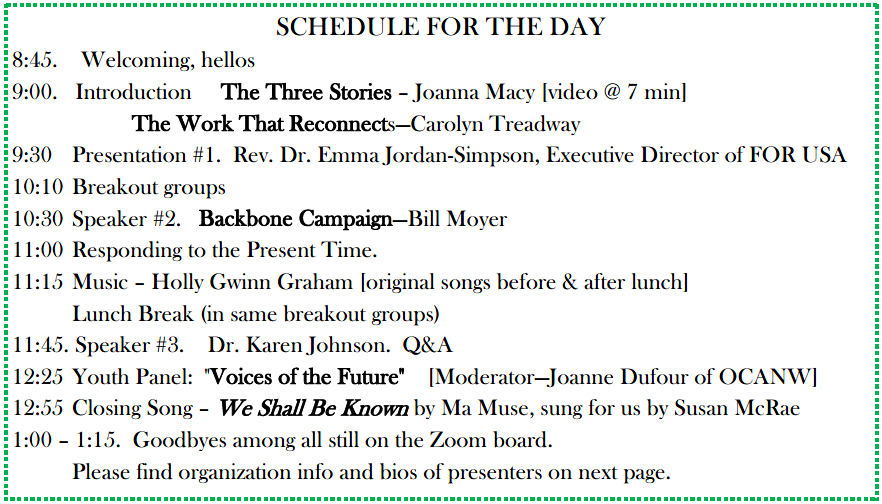
Need encouragement? Join Side With Love for Monday Movement Moments, Nov. 2,9 Online
 We are proud of the ways our Faith continues to #SideWithLove and be present to the World. We are in the final days before a historic election and we want to offer you an opportunity to provide Faithful Witness at The Polls. Whether your congregation is a polling site or is interested in offering some warmth and kindness at undoubtedly tense polling stations, we have ideas for how we can offer faithful responses that are at the heart of Side With Love. You can view the 30 minute webinar here.
What does it mean to continue to “harvest our power” when we are tired or overwhelmed? There's no magical fix, but knowing you are NOT alone and that others can help find the answers helps.
Join Side With Love on Monday Movement Moments for a 30-minute check-in and highlights of what’s happening across the country and ways you can get involved. Monday Movement Moment Nov. 2,9 at 9:30am PT. You can watch past episodes here.
We are proud of the ways our Faith continues to #SideWithLove and be present to the World. We are in the final days before a historic election and we want to offer you an opportunity to provide Faithful Witness at The Polls. Whether your congregation is a polling site or is interested in offering some warmth and kindness at undoubtedly tense polling stations, we have ideas for how we can offer faithful responses that are at the heart of Side With Love. You can view the 30 minute webinar here.
What does it mean to continue to “harvest our power” when we are tired or overwhelmed? There's no magical fix, but knowing you are NOT alone and that others can help find the answers helps.
Join Side With Love on Monday Movement Moments for a 30-minute check-in and highlights of what’s happening across the country and ways you can get involved. Monday Movement Moment Nov. 2,9 at 9:30am PT. You can watch past episodes here.
Washington Can't Wait group plans environmental action
Washington Can't Wait (WCW) is a movement of environmental activists founded by FutureWise, a statewide environmental group. According to the WCW website,"Washington Can’t Wait Campaign is building a grassroots movement across Washington to pressure our legislature in the 2021 legislative session to pass major updates to the Growth Management Act that would incorporate policy to address climate change, affordable housing and environmental justice." Events in the fall include Zoom meetings on October 29th on the Growth Management Act, a priority of the Environmental Priorities Coalition; on November 12 on land-use planning; on November 23 on housing; and December 9 on environmental justice. More details and registration are available on the WCW website. Most of these issues will come up in the 2021 Washington State Legislature.
Mike Yarrow Peace Fellowship Basic Training for Peace Teams, Oct. 25, online
How can organizers of nonviolent mass protest actions help ensure those actions won't be "hijacked", and thus made less effective, by violent flanks, outside groups, and covert provocateurs? How can we help ensure that health guidelines are followed during protests, to minimize the risk of harm from a deadly virus?
 Basic Training for Peace Teams:
Keeping Non-Violent Discipline
October 25, 6:30 to 8:30 pm
Dr. Tom Hastings, of Portland State University Conflict Studies Program and Adam Vogal of Portland Peace Team will provide a Zoom training on basic peacekeeping and de-escalation theory and skills to keep mass protests nonviolent. This training is designed for those who want to be trained to serve in a "peace team."
Basic Training for Peace Teams:
Keeping Non-Violent Discipline
October 25, 6:30 to 8:30 pm
Dr. Tom Hastings, of Portland State University Conflict Studies Program and Adam Vogal of Portland Peace Team will provide a Zoom training on basic peacekeeping and de-escalation theory and skills to keep mass protests nonviolent. This training is designed for those who want to be trained to serve in a "peace team."
Sunrise Seattle Hub Strategy Session, Sept. 26, 2020, Online
 This Saturday, September 26th from 5-8pm, Sunrise Seattle will be holding a hub strategy session. If you have an interest in helping our hub to craft a strategy for the months leading up to January 2021, we would love for you to join us! You can register here.
Why: We’ve done amazing work since Sunrise Seattle began, especially in the last few months. In order to continue showing up for the uprising for Black Lives and other movements across the city and organizing our generation, and do it even bigger and better over time; we need to unify our work around a long-term strategy. We need a clearer vision for how the Seattle hub will work towards building people power, political power, and the people’s alignment for a Green New Deal this fall, and Sunrise National just released a toolkit to help us do just that.
How: We'll be having a participatory session open to our entire hub, and we're also setting up systems for everyone to give input without having to make the meeting. To facilitate that, we're sharing the agenda for the strategy session, a shorter version of the Sunrise National Fall Strategy Guide, and an example strategy so every member can be involved and propose strategies.
There will be 3 more days for people to develop proposals for strategies or specific goals. These proposals will be discussed in the first strategy session to evaluate their strengths and weaknesses and develop our hub strategy and goals.
Once we have a first draft of our hub's strategy, it will be posted in the #strategic_planning_session channel on our Slack, and hub members will have a week to provide feedback in that Slack channel before our second strategy session, where we'll incorporate any feedback and come up with a final strategy. (Slack is a messaging tool we use to share ideas and collaborate - everyone is welcome to join.)
Please join the #strategic_planning_session channel on our Slack! The channel will be a place where people can discuss strategy, view other proposals, and build off each others’ ideas. Even if you can't come to the strategy session, you can develop proposals or explain your vision for our hub this fall in that channel, and your contributions will be taken into consideration during our planning session.
Excited but unsure of how to draft your own strategy proposal?: The Sunrise National fall strategy guide is a great resource for drafting your own proposals. In addition, our Trainings Team put together a document explaining the Act-Recruit-Train cycle that Sunrise uses, our theory of change, and key questions to keep in mind when drafting a proposal for a strategy or goal.
Celebrate National Public Lands Day
To cel ebrate National Public Lands Day 2020, the Mountains to Sound Greenway is running the campaign: Love Your Lands. Due to COVID-19, outdoor recreation spaces are receiving increased use. It is great that folks are getting outside, but this increased use has also increased the amount of litter in public spaces. The Love Your Lands campaign is to encourage folks to get outdoors and love your public natural spaces by picking up trash. Picking up trash can be fun and Mountains to Sound Greenway is offering a top collector prize. There is also a fun, free downloadable app call Litterati to share your litter collecting program. The event is now until Sept. 26th.
CLICK HERE FOR LITTERATI INSTRUCTIONS
CLICK HERE FOR EVENT INFO & SIGN UP
ebrate National Public Lands Day 2020, the Mountains to Sound Greenway is running the campaign: Love Your Lands. Due to COVID-19, outdoor recreation spaces are receiving increased use. It is great that folks are getting outside, but this increased use has also increased the amount of litter in public spaces. The Love Your Lands campaign is to encourage folks to get outdoors and love your public natural spaces by picking up trash. Picking up trash can be fun and Mountains to Sound Greenway is offering a top collector prize. There is also a fun, free downloadable app call Litterati to share your litter collecting program. The event is now until Sept. 26th.
CLICK HERE FOR LITTERATI INSTRUCTIONS
CLICK HERE FOR EVENT INFO & SIGN UP
Webinar on Agriculture, Food and Climate
On September 15 a webinar on agriculture, food and climate will cover issues of land use, soil policies, food supply, environmental justice and climate change. The webinar is sponsored by the EU Delegation to the U.S. (European Union Embassy) in DC. Registration is free, at https://events.euintheus.org/events/bringing-farmers-to-the-table-agriculture-climate-economy-and-equity/?sf128592465=1
Winning the Green New Deal Book Launch from Sunrise, Aug. 27, online.
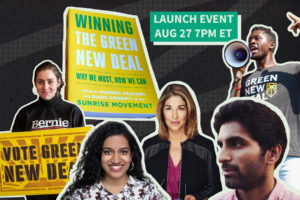 It’s finally here. WINNING THE GREEN NEW DEAL is out in the world today! If you haven’t yet picked up a copy, you can get one here.
I am so excited to share this book with everyone. Guido and Varshini worked very hard to gather brilliant people together and make this the definitive guide for what the Green New Deal is, why we need it, and how we win it. This book is a chance for us as Sunrisers to reground in what we’ve been working toward and an opportunity to invite others into the movement in a new and exciting way.
Continue reading