Under Construction
HB 1412 Legal Financial Obligations
In 2018, the legislature passed a bill reducing legal financial obligations (LFO) imposed on defendants convicted of crimes. At that time, LFO legislation was one of the priorities identified at the 2017 Justice Summit. LFO’s are court costs and other financial costs that recently incarcerated people are required to pay after release, and they can deter them from paying other costs such as housing or job searches. HB 1412 would reduce these costs even more because it:
- Allows a court to refrain from imposing or waive full or partial restitution and accrued interest owed to any insurer or entity that is not an individual if the offender does not have the means to pay.
- Allows a court to not impose interest on restitution after inquiring into and considering specified factors and input of the victim.
- Revises standards for the waiver of accrued interest on restitution and non-restitution obligations.
- Revises the time periods in which judgments for restitution and non restitution legal financial obligations may be enforced.
- Establishes a revised standard of indigency for purposes of a number of provisions applicable to legal financial obligations.
Continue reading
Fair Fight Bond Fund Accepting Applications for Those Detained by Immigration in WA
 The Washington Immigrant Solidarity Network is thrilled to share that the Fair Fight Bond Fund is open and accepting applications for people who are detained by immigration in the State of Washington and need support with paying bond.
To request assistance with paying a bond, a request form must be completed. This request form will be reviewed by the Fair Fight Bond Fund steering committee. The steering committee is made up of seven community members, including people who have been directly impacted and have experienced being in immigration detention. All requests for funds will be fully considered on a case-by-case basis and the steering committee will try to pay as many bonds as possible, so long as funds are available. The steering committee will aim to meet on a weekly basis to review applications and give responses as soon as possible.
The steering committee will aim to prioritize individuals who are facing especially difficult situations due to being detained. This includes applicants who are facing physical and/or mental health issues that are aggravated by being detained; applicants who are the primary caretakers to dependents who are facing immediate hardship due to the applicant’s detention; applicants who face serious economic hardship and have no or limited support, options, and resources to pay their bond; applicants who will face negative long-term effects on their immigration status due to being detained; applicants who are members of the LGBTQ community; and applicants who face marginalization based on their language, race, ethnicity, or religion.
Please find the English version of the application at this link: https://bit.ly/
The Washington Immigrant Solidarity Network is thrilled to share that the Fair Fight Bond Fund is open and accepting applications for people who are detained by immigration in the State of Washington and need support with paying bond.
To request assistance with paying a bond, a request form must be completed. This request form will be reviewed by the Fair Fight Bond Fund steering committee. The steering committee is made up of seven community members, including people who have been directly impacted and have experienced being in immigration detention. All requests for funds will be fully considered on a case-by-case basis and the steering committee will try to pay as many bonds as possible, so long as funds are available. The steering committee will aim to meet on a weekly basis to review applications and give responses as soon as possible.
The steering committee will aim to prioritize individuals who are facing especially difficult situations due to being detained. This includes applicants who are facing physical and/or mental health issues that are aggravated by being detained; applicants who are the primary caretakers to dependents who are facing immediate hardship due to the applicant’s detention; applicants who face serious economic hardship and have no or limited support, options, and resources to pay their bond; applicants who will face negative long-term effects on their immigration status due to being detained; applicants who are members of the LGBTQ community; and applicants who face marginalization based on their language, race, ethnicity, or religion.
Please find the English version of the application at this link: https://bit.ly/
Continue reading
Fair Bond Fund to Help Release Detained Immigrants
As COVID-19 continues to impact our communities, those most at risk are the members of our community who are in detention. Last week, La Resistencia broke the news that dozens of immigrants at the Northwest Detention Center had been exposed to COVID-19 by a GEO guard. Last month, we heard how in Georgia, immigrants held at a detention center were subject to forced hysterectomies and general medical neglect. These reminders are just two of the many reasons that we know immigration detention centers should be shut down and ICE should be abolished.
 While we prepare for the long-term fight, we are also doing what we can to free the members of our communities who are in immigration detention.
I am pleased to announce that the Fair Fight Bond Fund is gearing up to re-open in the coming weeks to pay the immigration bond funds of community members detained by ICE in Washington State.
Next week, we will be participating in Fall Freedom Day---an effort coordinated by the National Bail Fund Network to pay bonds to free hundreds of community members from immigration detention in one day. Last year, the NBFN moved $2.1 million and was able to pay the bonds of nearly 200 people detained by ICE across the country. The Fair Fight Bond Fund will be participating in these efforts this year and hope that with our partners across the country we can release even more of our community members.
As we work out some of the final details before we officially resume accepting and reviewing applications to help pay for immigration bonds, we ask that you consider donating to the Fair Fight Bond Fund so that we can have as much money in the fund to start paying bonds.
If you have any questions, interest in volunteering with the bond fund, or other comments, please contact me at vanessa@waisn.org. Please send questions or requests about paying for bonds for specific cases to bond@waisn.org.
In Solidarity,
While we prepare for the long-term fight, we are also doing what we can to free the members of our communities who are in immigration detention.
I am pleased to announce that the Fair Fight Bond Fund is gearing up to re-open in the coming weeks to pay the immigration bond funds of community members detained by ICE in Washington State.
Next week, we will be participating in Fall Freedom Day---an effort coordinated by the National Bail Fund Network to pay bonds to free hundreds of community members from immigration detention in one day. Last year, the NBFN moved $2.1 million and was able to pay the bonds of nearly 200 people detained by ICE across the country. The Fair Fight Bond Fund will be participating in these efforts this year and hope that with our partners across the country we can release even more of our community members.
As we work out some of the final details before we officially resume accepting and reviewing applications to help pay for immigration bonds, we ask that you consider donating to the Fair Fight Bond Fund so that we can have as much money in the fund to start paying bonds.
If you have any questions, interest in volunteering with the bond fund, or other comments, please contact me at vanessa@waisn.org. Please send questions or requests about paying for bonds for specific cases to bond@waisn.org.
In Solidarity,
Continue reading
A BAIL REFORM TOOL INTENDED TO CURB MASS INCARCERATION HAS ONLY REPLICATED BIASES IN THE CRIMINAL JUSTICE SYSTEM
In 2011, as part of a criminal justice reform package meant to reduce incarceration and its related expenditures, Kentucky became among the first states to require judges to use a risk assessment as part of their pretrial decisions. Similar risk assessments have since proliferated across the country in recent years, as jurisdictions that have decided cash bail is unjust — and potentially unconstitutional — have had to grapple with the circumstances in which to detain people who are too poor to come up with the money.
Risk assessments can give the veneer of a more scientific approach than a judge’s discretion, while dampening critics who argue that getting rid of cash bail allows dangerous people to be released. A large amount of past court data is run through a system that determines what factors appear to correlate with higher rates of rearrest or failure to appear for later court dates. Each jurisdiction decides what factors to weigh more heavily, and the algorithm creates a matrix to determine whether someone is low risk, moderate risk, or high risk. Jurisdictions then decide how the scores get used; in most places, they are given to a judge to consider when deciding whether and how to release someone.
Read more here.
Continue reading
Now is an Excellent Time to Contact Your Legislators About Your Concerns
 It is quiet right now in the Legislature, which makes it the perfect time to reach out to our Representatives and Senators and let them know what is important to us.See leg.wa.gov site for their contact information.
I am suggesting three issues that may resonate with JUUstice Washington members. This list is one guy’s best guess of those few priorities that have-
It is quiet right now in the Legislature, which makes it the perfect time to reach out to our Representatives and Senators and let them know what is important to us.See leg.wa.gov site for their contact information.
I am suggesting three issues that may resonate with JUUstice Washington members. This list is one guy’s best guess of those few priorities that have-
-
- had some traction in the 2000 - 2019 legislatures;
- been or currently are priorities for our justice allies, and
- have precedent in other states or jurisdictions.
- Clean Fuel Standards - 2019 House Bill 1110 - Passed the House, Active in the Senate
- Mitigation measures to preserve the Southern Resident Orcas - Supported by the Governor and an active issue in 2019
- Eliminate Cash Bail in Washington State - Cash Bail imprisons the poor, who cannot post bail from family resources.
Kelly Thompson
Legislative Advocacy Action Team
JUUstice Washington
Continue reading
Justice Reform in Thurston County: What's Cooking? Nov. 18, 2019, Olympia WA
Patrick O'Connor, Director of Thurston County Public Defense, will discuss new developments in the Thurston County justice system. These include bail reform as a part of a new risk-assessment tool for pretrial release; the First Look project that evaluates diversion potential for new arrestees; ICE arrests and the Keep Washington Working Act; and planning for an LFO Reconsideration Day.
When: Monday, Nov. 18th, 7:00pm
Where: Olympia UU Congregation, Olympia WA
Sponsored by Justice not Jails.
Continue reading
End Money Bail Webinar, October 23, 2019, online.
 We’re inviting congregations and communities to join us for our End Money Bail 2020 Community Kick-Off, a webinar on Wednesday, October 23 at 5 p.m. PT.
Join us as we welcome back partners and leaders from last year’s immensely successful Babies & Bailouts campaign and explore new ways to live into our universalist value that no one is free unless all of us are free. If you want to get involved, but can’t make the October 23 webinar, sign up and we’ll send you a recording of it directly.
Register now: http://bit.ly/EndMoneyBail2020Kickoff
Whether you’re unfamiliar with the campaign to end money bail or joining us again after participating last year, we encourage you to form a team to work through our End Money Bail Community Workbook. It’s designed to educate, build power, and take collective, informed action. We invite groups to participate and map power, develop skills, create an action plan, and support local and national efforts to #EndMoneyBail.
Will you join us?
We’re inviting congregations and communities to join us for our End Money Bail 2020 Community Kick-Off, a webinar on Wednesday, October 23 at 5 p.m. PT.
Join us as we welcome back partners and leaders from last year’s immensely successful Babies & Bailouts campaign and explore new ways to live into our universalist value that no one is free unless all of us are free. If you want to get involved, but can’t make the October 23 webinar, sign up and we’ll send you a recording of it directly.
Register now: http://bit.ly/EndMoneyBail2020Kickoff
Whether you’re unfamiliar with the campaign to end money bail or joining us again after participating last year, we encourage you to form a team to work through our End Money Bail Community Workbook. It’s designed to educate, build power, and take collective, informed action. We invite groups to participate and map power, develop skills, create an action plan, and support local and national efforts to #EndMoneyBail.
Will you join us?
Continue reading
Hundreds of Unitarian Universalists protest new Spokane Co. Jail
Continue reading
Reforming Debtors Prison in Washington State makes sense (and dollars!)
On a given day in Washington State, up to 50% of the people in county jail are there because they are poor. Cash bail enforces a guilty until proven innocent structure on the poor. It does not have to be this way. According to 2019 studies by the Washington State Auditor, bail alternative services in Yakima and Spokane counties showed the following:
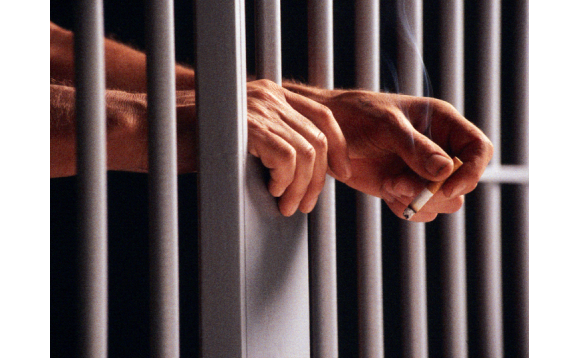 The benefits to those detained because they cannot afford bail are important. Several studies show people who stay in jail before trial often have worse outcomes in their legal cases, even after accounting for factors like criminal history. Multiple studies in different places show remaining in jail before trial increases the probability of conviction, guilty pleas and jail sentences, including longer sentences.
Continue reading
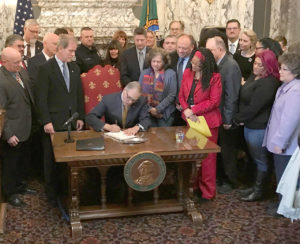
2019 Preliminary Summary of Legislation Passed by the Washington State Legislature
Continue reading