https://nativenewsonline.net/currents/historic-day-two-american-indian-women-become-members-of-congress/?fbclid=IwAR18jUoh79TCpO2ng-KOD91vP6oIpV-cWF2hJ_XvdvpzjnNpA2EmQ5NYQQg … [Read more...]
The push to free Tokitae – Interview
The Lummi Tribe is hoping 2019 will be the year an orca named Tokitae is freed from captivity. Named ‘Lolita’ by Miami’s Seaquarium, the animal has lived and performed in a man-made tank since 1970. The tribe and a host of animal rights groups are putting pressure on the Seaquarium to return her to … [Read more...]
Efforts to bring orca Tokitae home chronicled in new book
A Puget Sound Orca in Captivity: The Fight To Bring Lolita Home by Sandra Pollard. http://www.whidbeynewstimes.com/life/efforts-to-bring-orca-tokitae-home-chronicled-in-new-book/ … [Read more...]
Treaty Day Film Festival – Bellingham
Jan 19, 2019 at 2:30 PM – Jan 20, 2019 at 5:45 PM Children of the Setting Sun Productions, 1711 Ellis St. Suite 102, Bellingham, Washington Two days of films showcasing the resilience of Indigenous peoples in honor of the Point Elliot Treaty of 1855 between the Lummi Nation and the U.S. … [Read more...]
We are the change – A March for Women 3.0

Sunday, January 20, 2019 at 10 AM – 2 PM Occidental Square, 117 S Washington St, Seattle, Washington 98104 Heading into our 3rd year of the Women's March, We hear you! We hear our local communities and we believe that no one stands alone. It will take all of us to create real change. We ask … [Read more...]
Before reconciliation is possible, Canadians must admit the truth
We substitute United States for Canada and the same truth applies . . . Apologies don’t do a lot of good if you aren’t willing to do the hard, inconvenient work to rectify issues and be forgiven, just like land acknowledgments don’t do a lot of good if you’re violating Indigenous rights to … [Read more...]
Broken Promises: Continuing Federal Funding Shortfall for Native Americans
December 20, 2018. A new report by the U.S. Commission on Civil Rights finds that funding levels for Native American tribes are woefully inadequate despite the federal government's responsibility to provide for education, public safety, health care and other services under treaties, laws and … [Read more...]
Lobby Day for a Free Flowing Snake River

Tuesday, February 5, 2019 at 9 AM – 3 PM Olympia State Capital Building 416 Sid Snyder Ave SW, Olympia, Washington 98501 Join us for the lobby day for a free-flowing Snake River in Olympia on Tuesday, February 5th. We will be meeting with Washington State Legislative representatives and … [Read more...]
Indigenous Action – San Juan Islands National Monument
WhiteSwan Environmental, a local Native group, is requesting our assistance in helping bring more recognition of indigenous perspectives to the care and management of the San Juan Islands Monument. A commenting period, which ends January 3, 2019 is open for public comment and we are being asked to … [Read more...]
Your Gift Empowers Us All

Reach beyond the mundane Contribute, today Now is the time to help us reach beyond the mundane. Our vision to empower people, with a new and more powerful thrust, to build a just world in which all people thrive. By supporting JUUstice Washington right now, you will be helping us to achieve … [Read more...]
Unist’ot’en Camp in Need of Support Now!
On December 14th, the British Columbia Supreme Court ruled in favor of an injunction against the Unist’ot’en Camp. This injunction is requiring that the gate blocking the way into the pipeline construction area to be removed so Coastal GasLink (as subsidiary of TransCanada) can get there and begin … [Read more...]
Canadian Court gives Coastal Gasoline permission to violate Indigenous rights
The Bellingham Unitarian Fellowship and other UU congregations have supported the Unist'ot'en Camp in the past and the Camp will be needing more help as the BC Supreme Court moves against them. Watch for more … [Read more...]
A Native American tribe demands the return of its spiritual relative
https://religionnews.com/2018/12/10/a-native-american-tribe-demands-the-return-of-its-spiritual-relative-an-orca/?fbclid=IwAR0BzybJcOfK9KzhiczEbvLIvVMPKfi-Ami7uILMPsOM_0Oo96p6e_gsdNQ … [Read more...]
Windstorm Outtage Kills Millions of Young Salmon At WDFW Hatchery
http://nwsportsmanmag.com/windstorm-outtage-kills-millions-of-young-salmon-at-wdfw-hatchery-devastating-loss/?fbclid=IwAR2dvyQ9icIzZRgqDZME0BuANyJ8cRc3uuPj_RwztQB0_kLkVs_Knjz2HH0 … [Read more...]
Honoring Native Land in Your Congregation: A Truth and Reconciliation Process
Gary Piazzon writes: There is a plaque at the entrance of the UUCWI sanctuary acknowledging that the land it occupies was traditionally occupied by the Snohomish tribe.This was done as part of a truth and reconciliation process.A process of acknowledging and taking responsibility of wrongs done … [Read more...]
Why famished orcas may have to wait 90 years for more salmon
The 2005 federal recovery plan for chinook salmon had more ambitious timelines: 25 years in the Skagit, 50 years in the rest of Puget Sound. Either pace might be far too slow for the region’s remaining 74 southern resident killer whales, starving for salmon today. Read more here. … [Read more...]
Pacific Northwest tribe enlists unusual allies in fight to save the Salish Sea from fossil fuel threats: museums
https://lastrealindians.com/pacific-northwest-tribe-enlists-unusual-allies-in-fight-to-save-the-salish-sea-from-fossil-fuel-threats-museums/mattremle/ … [Read more...]
Pop-Up Museums as Political Organizing: Can Totem Poles Help Turn the Tide on Fossil Fuels?
For the last six years, the new totem poles have focused on issues relating to the fossil fuel industry. The newest carving emphasizes risks to the Salish Sea (off northwest Washington and southwest British Columbia) and its dwindling population of orcas, or killer whales, if proposed industry … [Read more...]
Samish Nation celebrates approval of land-into-trust application
It took more than eight years but the Samish Nation has finally secured approval of a land-into-trust application in Washington state.And though the decision is for a relatively small parcel of 6.70 acres, the tribe is celebrating the historic action. In the past 22 years, the Bureau of Indian … [Read more...]
NORTHWEST TRIBAL LEADERS TESTIFY IN OPPOSITION TO CANADIAN PIPELINE EXPANSION
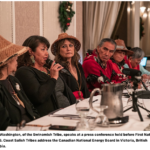
Opposition to the Trans Mountain pipeline from Coast Salish Tribes on both sides of the U.S.-Canada border continued today with indigenous people of the Salish Sea region testifying before the Canadian National Energy Board. Four U.S. Coast Salish Tribes — the Swinomish Indian Tribal Community, … [Read more...]